

Zeus: Origins, Myths, Symbols & Ancient Greek Art


Few figures in world mythology have shaped literature, philosophy, religion, art, and popular culture as profoundly as Zeus. Instantly recognizable by his thunderbolt and eagle, Zeus stands at the summit of the Greek pantheon as ruler of the heavens, guardian of justice, and sovereign of both gods and mortals. Yet reducing him to the familiar image of a bearded deity hurling lightning obscures the remarkable complexity of his origins and evolution. Zeus is not merely a weather god or divine king. He represents thousands of years of cultural exchange, religious development, political ideology, artistic innovation, and storytelling that stretches from the Bronze Age to the modern world.
To understand Zeus is to understand much of Greek mythology itself. His stories intertwine with nearly every major hero, monster, and deity, while his image became one of antiquity's defining artistic subjects. Whether viewed through archaeology, linguistics, religion, literature, or fine art, Zeus remains one of humanity's most enduring mythological figures.
The Name of Zeus
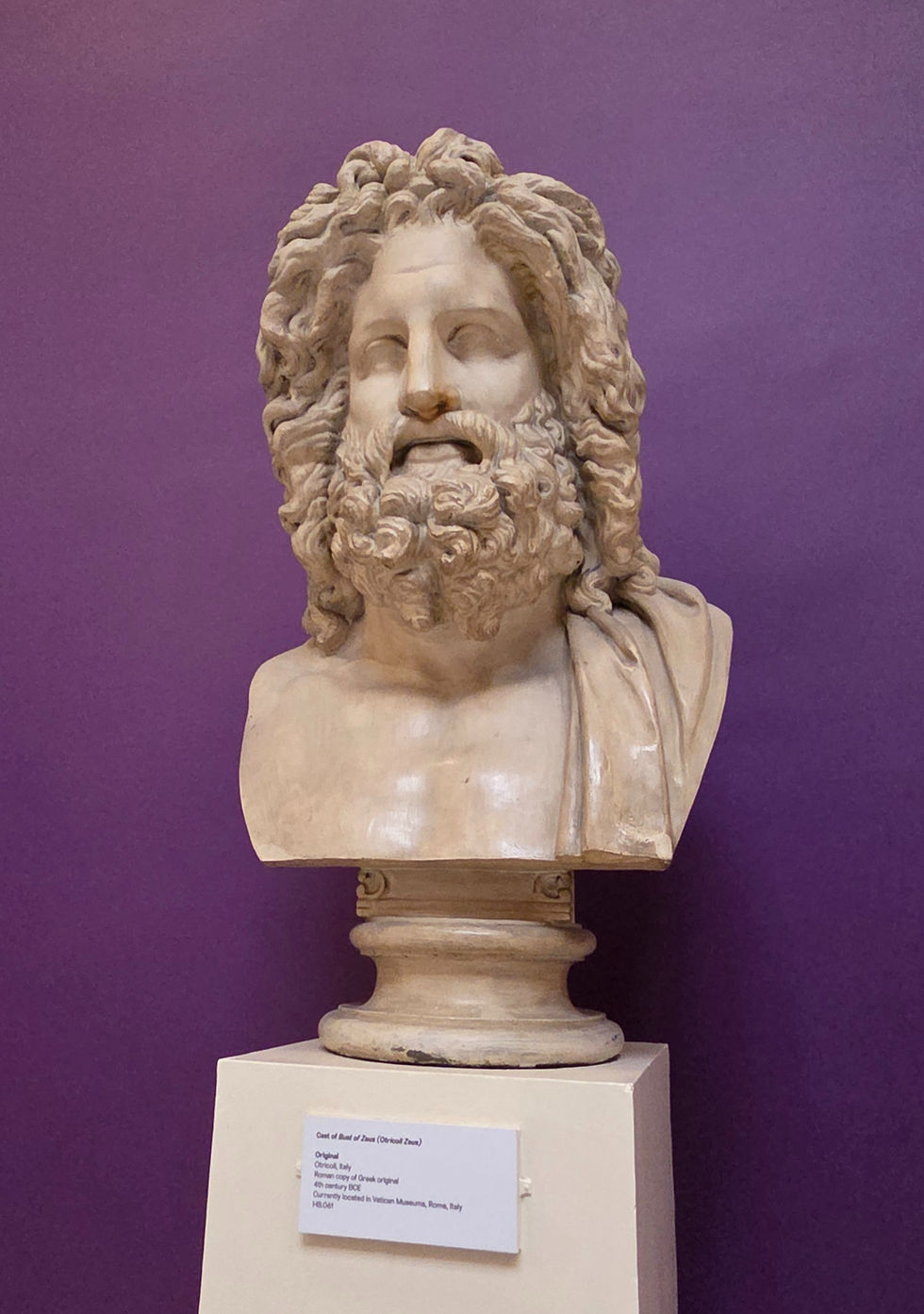
The Greek name Ζεύς (Zeús) traces its ancestry to one of the oldest reconstructed words in the Indo-European language family: *Dyeus, meaning "bright sky" or "daylight sky." This same linguistic ancestor produced several names that remain familiar today.
The Roman Jupiter derives from the Latin Iuppiter, itself a contraction of Diespiter, meaning "Sky Father." The Sanskrit deity Dyaus Pitar shares the same origin, while even the word "deity" ultimately descends from this ancient linguistic root. These similarities are not coincidences but evidence that many Indo-European cultures inherited traditions centered on a celestial father god associated with the daytime sky.
Unlike many Greek gods whose origins remain obscure or distinctly local, Zeus preserves a remarkable linguistic continuity stretching back perhaps six thousand years. While the Greek Zeus developed a personality unique to Hellenic religion, his name still carries echoes of one of humanity's oldest surviving religious concepts.
Origins Before Greece
Although Zeus is considered quintessentially Greek, scholars generally agree that his origins are more complicated than Greek mythology itself suggests.
The earliest evidence for Zeus appears in Mycenaean Greece during the Late Bronze Age. Tablets written in the Linear B script, dating to roughly the 13th century BCE, contain the name di-we or di-wo, widely accepted as an early form of Zeus. These administrative records indicate that worship of Zeus already existed centuries before Homer composed the Iliad and the Odyssey. However, Zeus likely emerged through a blending of traditions rather than appearing fully formed.
The Proto-Indo-European Sky Father provided the linguistic and conceptual foundation. As Indo-European peoples migrated into the Greek peninsula, their sky deity encountered older religious traditions already flourishing in the Aegean. Archaeological evidence suggests that Minoan Crete emphasized powerful female divinities associated with fertility, mountains, caves, and nature. Rather than replacing these traditions entirely, Greek religion absorbed and transformed them. Crete would later become inseparable from Zeus' own birth story, perhaps preserving memories of older sacred sites that predated Olympian religion itself.
Near Eastern civilizations also influenced Zeus' development. Hittite, Hurrian, Babylonian, and Canaanite myths contain divine succession stories in which younger gods overthrow older generations. The Greek account of Uranus, Cronus, and Zeus reflects striking parallels with these traditions, though adapted into a uniquely Greek narrative. Rather than viewing Zeus as borrowed from any one culture, most historians understand him as the product of centuries of religious evolution across the eastern Mediterranean.
The Birth of the King of the Gods

No myth better illustrates Zeus' destined rise than the story of his birth. His father, Cronus, ruled the universe after overthrowing his own father, Uranus. Yet prophecy declared that one of Cronus' children would eventually overthrow him in turn. Determined to avoid his father's fate, Cronus swallowed each newborn child immediately after birth.
Hestia disappeared first. Then Demeter, Hera, Hades, and finally Poseidon. When Zeus was born, however, his mother Rhea devised a desperate plan. She secretly gave birth in a cave on Crete and wrapped a stone in infant clothing, presenting it to Cronus instead. Believing the deception, Cronus swallowed the stone while Zeus remained safely hidden.
Different traditions describe different guardians. Some claim the goat Amalthea nursed him with divine milk. Others say the nymphs Adrasteia and Ida cared for him. Yet others state the Curetes—armed warriors—clashed their weapons together to drown out the infant's cries so Cronus would never discover the deception.
Many caves on Crete later became sacred pilgrimage sites associated with this miraculous survival, demonstrating how mythology often attached itself to real landscapes and existing places of worship.
The Titanomachy
When Zeus reached adulthood, he returned to confront Cronus. Various versions describe how he tricked his father into drinking an emetic that forced him to vomit Zeus' swallowed siblings, who emerged alive despite years imprisoned within their father's body. Together they launched a cosmic war against the Titans known as the Titanomachy. The conflict lasted ten years.
Neither side could secure victory until Zeus freed the Cyclopes and the Hundred-Handed Giants from imprisonment in Tartarus. In gratitude, the Cyclopes forged divine weapons for the Olympians. Zeus received the thunderbolt. Poseidon received the trident. And Hades received the Helm of Darkness.
Armed with these gifts, the Olympians defeated the Titans. Most were imprisoned beneath the earth, guarded forever by the Hundred-Handed Giants, while Atlas received the famous punishment of supporting the heavens upon his shoulders. The Titanomachy established more than Zeus' kingship. It represented the triumph of order over primordial chaos and became the foundational political myth of Greek religion.
Division of the Cosmos
Following their victory, Zeus and his brothers divided creation by drawing lots. Zeus became ruler of the sky. Poseidon received dominion over the sea. Hades inherited the Underworld.
Importantly, the earth itself belonged to all three, though Zeus' authority as king gave him ultimate influence among gods and mortals alike. This division illustrates a recurring Greek principle: power was distributed rather than absolute. Even Zeus, despite his supremacy, could not entirely ignore Fate or erase the authority granted to other gods.
Zeus and Divine Justice
Modern audiences often associate Zeus primarily with thunder, but ancient Greeks viewed justice as equally central to his identity. He served as protector of strangers, travelers, refugees, guests, kings, treaties, oaths, and lawful governance. Hospitality—known as xenia—was sacred under Zeus' protection. Violating hospitality invited divine punishment regardless of social status.
Many of Greek mythology's cautionary tales revolve around failures of justice rather than simple acts of violence. Lycaon attempted to deceive Zeus and test his omniscience through cannibalism. Tantalus betrayed divine trust. Ixion violated sacred hospitality. Each received eternal punishment. Zeus' judgments reinforced moral expectations within Greek society, even if his own actions frequently appear contradictory by modern ethical standards.
The Contradictions of Zeus
Perhaps no Greek deity generates more modern criticism than Zeus. He is portrayed as wise yet impulsive. Compassionate yet merciless. A protector of marriage despite countless affairs. And a guardian of justice despite acts that often appear profoundly unjust.
These contradictions can frustrate readers approaching mythology as though it were a unified religious text. Greek mythology, however, developed over centuries through countless poets, playwrights, priests, local traditions, and oral storytellers. Zeus possesses multiple personalities because Greek mythology itself contains multiple voices.
His numerous relationships often symbolized political alliances between cities, the merging of local cults into Olympian religion, or the elevation of regional heroes through divine ancestry. While modern readers naturally judge these stories through contemporary values, ancient audiences often interpreted them through theological, symbolic, or political lenses. Understanding Zeus therefore requires balancing literary interpretation with historical context.
Symbols of Zeus
The thunderbolt remains Zeus' defining emblem, representing irresistible divine authority and celestial power. Forged by the Cyclopes, it became one of antiquity's most recognizable religious symbols. The eagle served as Zeus' sacred animal, embodying majesty, keen vision, and sovereignty over the skies. The oak symbolized endurance and divine wisdom. Sacred oak groves, especially at Dodona, became centers of prophecy where priests interpreted the rustling leaves as Zeus' voice. The scepter reinforced his role as king. The aegis, sometimes shared with Athena, represented divine protection and overwhelming power. These symbols frequently appear together in sculpture, painting, coins, mosaics, and temple decoration throughout the Greek world.
Zeus in Literature
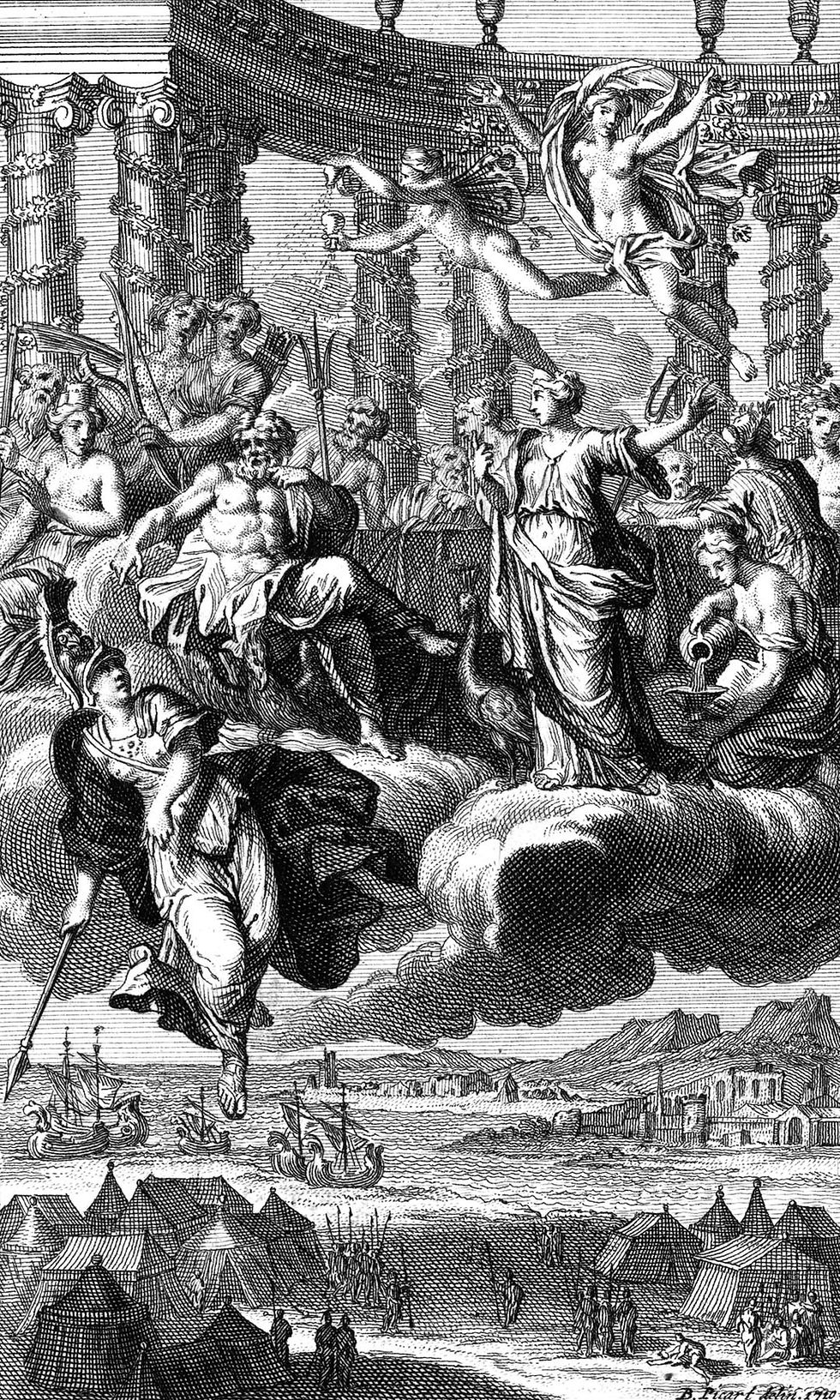
Zeus dominates nearly every surviving body of Greek literature. In Homer's Iliad, he presides over the Trojan War while balancing the competing desires of gods and the inescapable force of fate. Although he possesses immense authority, even Zeus cannot simply overturn destiny without consequence.
Hesiod's Theogony offers perhaps the most influential account of Zeus' rise to power, establishing the genealogy of the Olympians and defining much of later Greek mythology.
The tragedians—Aeschylus, Sophocles, and Euripides—expanded Zeus' role into questions of justice, tyranny, divine will, and human suffering. Rather than presenting a consistently benevolent deity, these playwrights often explored the tension between divine authority and mortal understanding.
Roman poets later adapted Zeus as Jupiter, extending his influence throughout Latin literature and ultimately into Renaissance scholarship.
Worship Across Greece
Unlike many Greek gods associated with specific cities or professions, Zeus enjoyed worship throughout the Greek world. Olympia became one of his greatest sanctuaries, hosting the Olympic Games every four years in his honor. Athletic competition functioned not merely as entertainment but as sacred devotion. Dodona, among Greece's oldest oracle sites, centered upon a sacred oak where priests interpreted the sounds of rustling leaves and bronze vessels to deliver Zeus' prophecies.
Numerous local forms of Zeus existed, each emphasizing different aspects of his authority. Zeus Xenios protected guests, Zeus Horkios oversaw oaths, Zeus Keraunios wielded lightning, and Zeus Soter acted as savior. Rather than separate gods, these epithets reflected different dimensions of one divine figure.
Zeus in Ancient Art
Zeus became one of antiquity's greatest artistic subjects because he represented ideal kingship, physical perfection, and divine authority. Early Archaic representations often appear rigid and heavily stylized, reflecting the artistic conventions of the seventh and sixth centuries BCE. By the Classical period, sculptors increasingly pursued anatomical realism, emotional restraint, and harmonious proportions.
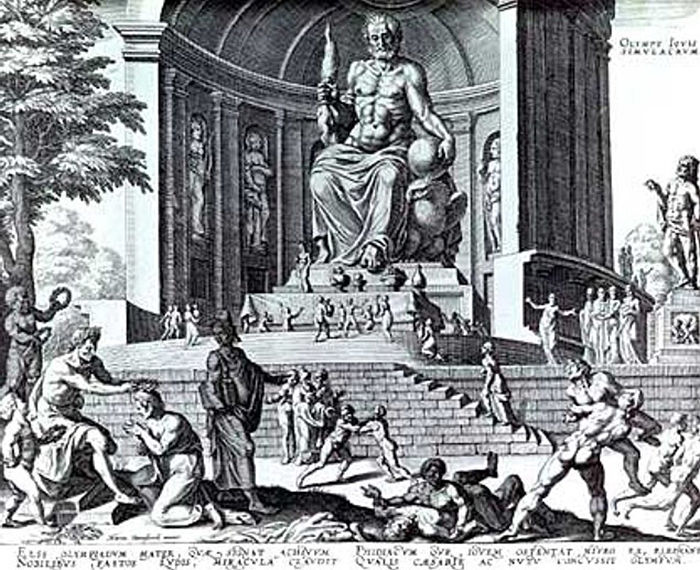
Perhaps the greatest artistic achievement associated with Zeus was the colossal statue created by Phidias around 435 BCE for the Temple of Zeus at Olympia. Constructed from ivory and gold over a wooden framework, the seated figure measured approximately forty feet tall. Ancient writers described Zeus holding Nike, the goddess of victory, in one hand while resting a richly decorated scepter in the other. The throne itself was lavishly adorned with mythological scenes crafted from precious materials.
Although the statue no longer survives, ancient descriptions and surviving coin images suggest it inspired awe throughout the Mediterranean. It was later recognized as one of the Seven Wonders of the Ancient World.
Greek vase painters frequently depicted Zeus during pivotal mythological moments, including the Titanomachy, the birth of Athena from his head, battles against giants, and encounters with heroes. Red-figure pottery, in particular, allowed artists to render expressive anatomy and elaborate drapery while emphasizing Zeus' mature, commanding appearance.
During the Hellenistic period, artists introduced greater emotional intensity and dramatic movement. Zeus' hair and beard became windswept, muscles more dynamic, and facial expressions more psychologically complex, reflecting changing artistic tastes.
Roman artists inherited these traditions almost unchanged. As Jupiter, Zeus appeared on imperial monuments, mosaics, frescoes, sarcophagi, coins, and triumphal architecture. His imagery became inseparable from imperial authority, reinforcing the emperor's association with divine legitimacy.
The Renaissance revived Zeus once more. Artists such as Michelangelo, Raphael, Rubens, and Titian drew inspiration from classical mythology, transforming Zeus into a recurring subject that blended Christian artistic techniques with ancient narratives. Later Neoclassical painters and sculptors continued to reinterpret him as the embodiment of idealized masculine power and reason.
Zeus Beyond Antiquity
Although the ancient Greek religion gradually disappeared with the spread of Christianity, Zeus never truly vanished. His stories survived through medieval manuscripts, Renaissance scholarship, Enlightenment education, Romantic literature, and modern archaeology.
Today he appears in novels, films, comic books, television, video games, and countless adaptations of Greek mythology. While these portrayals often simplify or modernize his personality, they testify to the remarkable longevity of his myth.
Modern scholarship continues to reveal new insights into Zeus through archaeological discoveries, comparative linguistics, and interdisciplinary research. Rather than viewing him solely as a fictional character, historians increasingly understand Zeus as a window into Bronze Age religion, ancient politics, evolving artistic traditions, and the cultural values of the civilizations that worshipped him.
Legacy
Zeus endures because he represents far more than lightning and kingship. He embodies humanity's attempt to explain authority, justice, natural forces, political order, family conflict, and the uncertain relationship between fate and free will. His myths preserve echoes of prehistoric religions, absorb influences from neighboring civilizations, and evolve alongside Greek society itself.
His image inspired some of the greatest achievements in ancient sculpture, painting, architecture, and literature. His name preserves linguistic roots reaching back thousands of years before classical Greece emerged. His stories remain foundational not only to mythology but also to Western art, philosophy, and storytelling.
For newcomers, Zeus serves as the gateway into Greek mythology, the figure through whom countless myths connect. For experienced students of antiquity, he remains an inexhaustible subject whose origins, symbolism, and evolving interpretations continue to challenge and reward scholarly investigation. Few mythological figures have left a legacy as vast, as influential, or as enduring as the King of the Olympians.
Continue the Journey
If you've enjoyed exploring the story of Zeus, you've already discovered one of the greatest inspirations behind my own fiction.
My novels frequently draw upon ancient mythology, weaving the old gods, forgotten legends, and timeless folklore into modern settings. While my stories imagine new possibilities and original narratives, I believe the myths themselves deserve to be remembered and appreciated for the rich history that inspired them.
One of my goals as an author is to introduce these ancient traditions to a new generation of readers. I hope my fiction encourages curiosity—not only about the characters on the page, but about the civilizations, beliefs, and stories that have endured for thousands of years.
Whether you're here because you love mythology, history, or simply enjoy a good story, I invite you to explore my novels and continue the journey. And if one of my books sends you down a rabbit hole researching Zeus, Athena, or any of the countless figures who shaped the ancient world, then I've accomplished exactly what I set out to do.


Comments