

John William Waterhouse: The Modern Pre-Raphaelite


John William Waterhouse (1849–1917) occupies a distinct position in the history of Victorian British painting. He is frequently described as a Pre-Raphaelite painter, yet the designation is somewhat misleading as it suggests that he was a member of the original Brotherhood. Waterhouse was born in the same year that the Brotherhood was established and came of age artistically after its principal members had already begun to move in different directions. His career instead belongs to the later Victorian period, when Pre-Raphaelitism had developed from a radical artistic rebellion into one of several influential currents within British art.
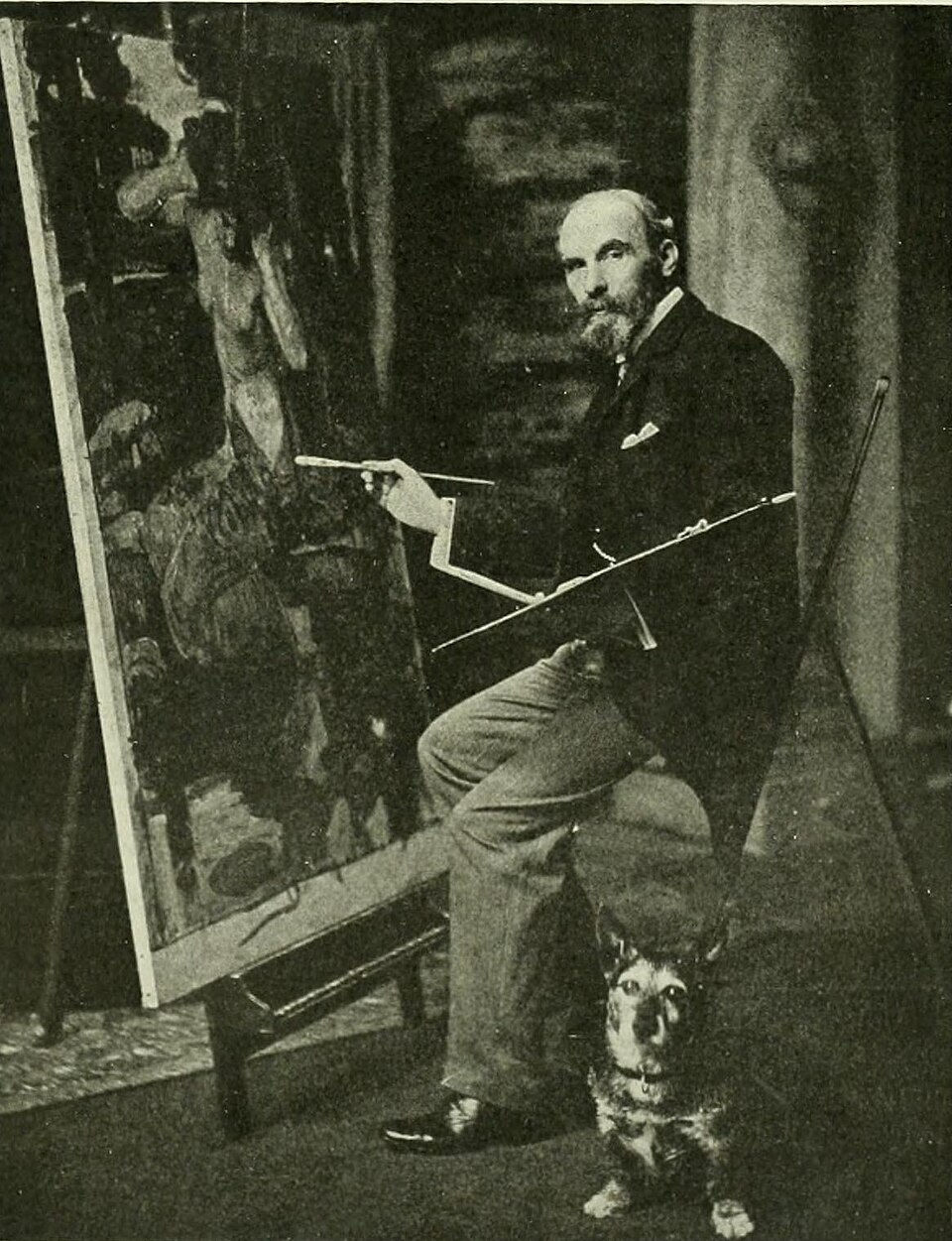
Waterhouse's importance lies precisely in this transitional position. His paintings combine the academic traditions in which he was trained with the medievalism, literary subjects, mythology, intense color, and emotional symbolism associated with the Pre-Raphaelites. At the same time, his later work demonstrates an awareness of newer approaches to painting. Particularly the atmospheric effects and looser handling associated with French Impressionism and the Newlyn School. The result was an art that looked backward to myth, poetry, and legend, while remaining responsive to the changing visual language of the late nineteenth century.
Today, Waterhouse is among the most recognizable Victorian painters. Works such as The Lady of Shalott, Ophelia, Hylas and the Nymphs, Circe Invidiosa, and The Magic Circle continue to attract viewers who may know little about Victorian art or the movements that shaped it. His enduring appeal, however, is not simply a matter of beautiful imagery. Waterhouse's paintings provide an unusually accessible entry point into the complicated artistic culture of late Victorian Britain.
Early Life and Education
Waterhouse was born in Rome on April 6, 1849, to English parents who were both artists. His father, William Waterhouse, worked as a painter in Italy, and the young Waterhouse spent his early years in an environment in which artistic practice was part of daily life. The family eventually returned to England, where Waterhouse assisted his father in the studio before pursuing formal training.
In 1870, Waterhouse entered the Royal Academy Schools in London. He initially studied sculpture rather than painting, an indication of the broad academic training available to artists of the period. He subsequently transferred his attention to painting, and the discipline of the Royal Academy became an important foundation for his career.
The Royal Academy represented the institutional center of British academic art. Students were trained in drawing, anatomy, composition, historical subjects, and the technical traditions considered essential to a professional artist. Waterhouse therefore did not emerge from an anti-academic or outsider tradition. His career developed within the very establishment that the first Pre-Raphaelites had challenged.
His early paintings reflect this education. Rather than immediately adopting the distinctive medieval and literary imagery for which he would later become famous, Waterhouse initially concentrated on classical and historical subjects. His work during the 1870s and early 1880s shows the influence of painters such as Lawrence Alma-Tadema and Frederic Leighton, both prominent figures in Victorian classicism. Waterhouse's large-scale compositions, archaeological settings, and interest in the ancient Mediterranean belong to this broader academic tradition.
Waterhouse also traveled extensively in Italy during the 1870s and early 1880s. These journeys reinforced an interest in Mediterranean light, architecture, landscape, and antiquity that remained important throughout his career. His relationship with Italy was particularly significant because classical antiquity was not merely an intellectual subject for Victorian artists; it was also connected to travel, archaeology, literature, education, and the cultural prestige attached to the ancient world.
From Academic Classicism to the Pre-Raphaelite Revival
Waterhouse's artistic development was gradual rather than revolutionary. His early paintings were firmly rooted in academic classicism, but by the 1880s his subject matter and visual language began to change.

One important turning point was Consulting the Oracle, exhibited in 1884. The painting demonstrated Waterhouse's continuing interest in antiquity while beginning to reveal the narrative and mysterious qualities that would become increasingly important in his mature work. The painting was purchased by Sir Henry Tate, an important patron and collector whose collection would eventually form the foundation of Tate Britain.
Waterhouse's increasing engagement with Pre-Raphaelite subjects became particularly apparent with The Lady of Shalott in 1888. The painting depicts the tragic heroine of Alfred, Lord Tennyson's poem as she leaves the tower in which she has been imprisoned by a supernatural curse. Rather than presenting a generalized medieval scene, Waterhouse captures the precise moment in which the narrative has become irreversible: the Lady has entered the boat, the tapestry has been abandoned, and the candles beside her are going out.
The subject connected Waterhouse directly with the literary and medieval interests of the Pre-Raphaelites. The resemblance to John Everett Millais's Ophelia is particularly significant. Waterhouse had attended Millais's major retrospective at the Grosvenor Gallery in 1886, and The Lady of Shalott contains unmistakable echoes of the earlier painting in its red-haired heroine, river setting, flowers, and emphasis on a woman caught at the moment of tragedy.
Yet Waterhouse did not simply imitate Millais. His treatment is softer and more atmospheric. The highly detailed botanical realism of early Pre-Raphaelite painting gives way to a more fluid handling of foliage, water, and distant landscape. The result is a painting that looks toward Pre-Raphaelitism while simultaneously moving beyond it.
This distinction is essential to understanding Waterhouse. He was not an original Pre-Raphaelite; he was a later artist who reinterpreted elements of Pre-Raphaelitism for a different artistic generation.
A Style Between Academic Art, Pre-Raphaelitism, and Impressionism
Waterhouse's mature style is difficult to assign to a single movement because it is fundamentally eclectic. His paintings retain the academic artist's concern with composition, drawing, historical subject matter, and technical competence. From Pre-Raphaelitism, he adopted an interest in literature, medieval legend, mythology, symbolic objects, saturated color, and emotionally charged female figures. From newer developments in European painting, he absorbed an interest in atmosphere, natural light, and more visible brushwork.

This combination can be seen particularly clearly in The Lady of Shalott. The painting contains the narrative specificity and symbolic richness associated with Pre-Raphaelite art, but its landscape is not treated with the painstaking surface description characteristic of Millais's Ophelia. Waterhouse's reeds and surrounding vegetation dissolve more readily into visible brushwork. His colors are also more subdued, with silvery greens and atmospheric blues replacing some of the jewel-like intensity of early Pre-Raphaelite painting.
This atmospheric quality became one of Waterhouse's defining characteristics.
His landscapes frequently serve an emotional rather than merely descriptive function. Water, forests, gardens, flowers, and twilight settings become spaces in which the boundaries between the natural and supernatural worlds seem uncertain. Figures appear to emerge from their environments rather than being placed against them. This is particularly effective in paintings such as The Magic Circle, Circe Invidiosa, and Hylas and the Nymphs, where nature itself seems to participate in the narrative.
Waterhouse was also particularly interested in moments of psychological transition. His subjects are often characters caught between two states: freedom and imprisonment, innocence and experience, life and death, desire and danger. The narrative has frequently begun before the viewer arrives, and its consequences are often already apparent.
This quality distinguishes Waterhouse from painters who treated mythology primarily as an opportunity to reconstruct the ancient world. His mythology is psychological. The ancient stories become vehicles for exploring fear, desire, temptation, loss, transformation, and fate.
Women, Mythology, and the Victorian Imagination
Waterhouse is especially associated with his representations of women. Many of his most famous paintings center upon female figures drawn from Greek mythology, Arthurian legend, Shakespeare, and nineteenth-century poetry.

These women are often beautiful, but beauty alone does not define their significance. They are frequently agents or victims of powerful forces: Circe possesses supernatural authority; the Lady of Shalott is constrained by a curse; Ophelia is psychologically and physically overwhelmed; the nymphs in Hylas and the Nymphs represent irresistible temptation.
The recurrence of these subjects reflects broader Victorian interests. Classical mythology and medieval literature were deeply embedded in nineteenth-century British education and culture. Artists, writers, architects, composers, and designers repeatedly returned to the ancient and medieval past as a way of addressing contemporary questions about morality, sexuality, beauty, social roles, and human desire. Scholarship on Waterhouse has consequently emphasized that his classical paintings were not simply escapist fantasies but participated in the cultural concerns of his own period.
His female figures can therefore be understood within a much larger Victorian tradition of the "dangerous woman" or femme fatale. Figures such as Circe, the Sirens, and other mythological women allowed artists to explore attraction and fear simultaneously. Waterhouse's women are frequently visually alluring, but their stories are rarely uncomplicated. Beauty may conceal danger, vulnerability, power, or impending tragedy.
Waterhouse and the Royal Academy
Despite his association with Pre-Raphaelite subject matter, Waterhouse remained firmly connected to the British academic establishment. His work was accepted for the Royal Academy's Summer Exhibition beginning in 1874, and he exhibited there consistently for most of his career. In 1885, he was elected an Associate of the Royal Academy, and in 1895 he became a full Royal Academician. He also taught and participated in the institutional life of the art world. This institutional success is important because it complicates the familiar division between "academic" and "Pre-Raphaelite" art.
The original Pre-Raphaelite Brotherhood had emerged in opposition to aspects of academic convention. By Waterhouse's generation, however, many of those once-radical ideas had been absorbed into the broader Victorian art establishment. Pre-Raphaelite imagery could appear in major exhibitions, while artists could simultaneously maintain academic credentials. Waterhouse represents this transformation particularly well. What had once been revolutionary became part of the artistic vocabulary available to a successful late-Victorian painter.
Influence and the "Modern Pre-Raphaelite"

Waterhouse's influence is best understood not as the creation of a formal school but as part of the continuing evolution of British romantic and figurative painting.
He demonstrated that subjects drawn from myth, medieval literature, and poetry could remain relevant within a changing artistic environment. Rather than reproducing early Pre-Raphaelite techniques exactly, he adapted their concerns to the visual language of the late nineteenth century.
The term "modern Pre-Raphaelite" has consequently become closely associated with Waterhouse. The description recognizes the contradiction at the center of his career: he looked backward while simultaneously absorbing contemporary developments. His work belonged to a generation that inherited Pre-Raphaelitism rather than originating it.
His position between traditions also helps explain why his reputation changed during the twentieth century. As modernism transformed the critical understanding of painting, Victorian academic and narrative art fell considerably out of favor. Waterhouse, despite having been commercially and critically successful during his lifetime, was increasingly marginalized by twentieth-century art histories that emphasized formal innovation and avant-garde movements.
The revival of interest in Victorian art eventually brought Waterhouse back into the broader history of nineteenth-century painting. His work became especially visible through reproductions, exhibitions, collecting, and scholarship. The Royal Academy's 2009 exhibition J. W. Waterhouse: The Modern Pre-Raphaelite was particularly important in reassessing his position and attracting more than 111,000 visitors.
Why Waterhouse Remains Relevant
Waterhouse's continuing popularity can sometimes obscure the historical complexity of his work. His paintings are reproduced extensively on posters, book covers, calendars, postcards, and online platforms, making his imagery familiar even to people who have never studied Victorian art. Yet this familiarity is not necessarily evidence of superficial appeal. Waterhouse's work remains relevant because the questions contained within his paintings have not disappeared.

His fascination with mythology continues to resonate in a culture that repeatedly revisits ancient stories through literature, film, television, illustration, and contemporary art. His interest in women caught between power and vulnerability remains particularly open to reinterpretation. Modern viewers can admire the visual beauty of Circe Invidiosa while also questioning the assumptions about gender and desire embedded within the image. They can see The Lady of Shalott as a Victorian literary illustration while also interpreting it as a meditation on isolation, creativity, choice, and fatal consequence.
Waterhouse's paintings also remain relevant because they demonstrate that artistic movements are rarely as neatly separated as textbooks sometimes suggest. He did not choose between academic painting, Pre-Raphaelitism, classicism, Romanticism, and newer approaches to landscape. He absorbed elements of each and produced something that belonged entirely to none of them.
That quality is particularly valuable from an art-historical perspective. Waterhouse provides a case study in how artistic traditions survive by changing. Pre-Raphaelitism did not simply end when the original Brotherhood dispersed. Its ideas entered the work of later artists, designers, illustrators, writers, and other creative figures. Waterhouse was one of the painters through whom those ideas were transformed for a new era.
The Enduring Appeal of Waterhouse
John William Waterhouse died in London on February 10, 1917, after a career that had spanned a period of considerable transformation in European art. He had begun within the academic traditions of Victorian painting and ended his career in a world increasingly shaped by modernism. His historical importance does not depend on declaring him the greatest painter of his generation, nor does it require placing him neatly within a single artistic movement. His significance lies in the way his work reveals the intersections between several traditions.

Waterhouse took the academic discipline of his Royal Academy education and applied it to subjects drawn from mythology, medieval legend, Shakespeare, and poetry. He absorbed the emotional and literary concerns of the Pre-Raphaelites without belonging to their original movement. He incorporated atmospheric approaches associated with newer European painting without abandoning narrative or figurative art. His paintings therefore occupy an unusual middle ground between tradition and modernity.
That middle ground is one reason his art continues to speak to contemporary audiences.
For viewers encountering Waterhouse simply because they are drawn to the beauty of his paintings, there is a deeper history beneath the surface: the history of Victorian classicism, the legacy of Pre-Raphaelitism, the changing role of the Royal Academy, the Victorian fascination with mythology and literature, and the gradual movement toward a more atmospheric and modern approach to painting.
For students of art history, Waterhouse offers something equally valuable. His career demonstrates that movements do not exist in isolation and that artistic change is rarely a clean succession of one style replacing another. Ideas overlap, persist, and are reinvented.
Waterhouse's art remains compelling because it embodies that process. His paintings look toward the past, but they were products of their own rapidly changing age. More than a century after his death, they continue to invite viewers into the same world of myth, literature, beauty, danger, and uncertainty that made them distinctive in the first place.


Comments