

Arrephoria Festival of Athens

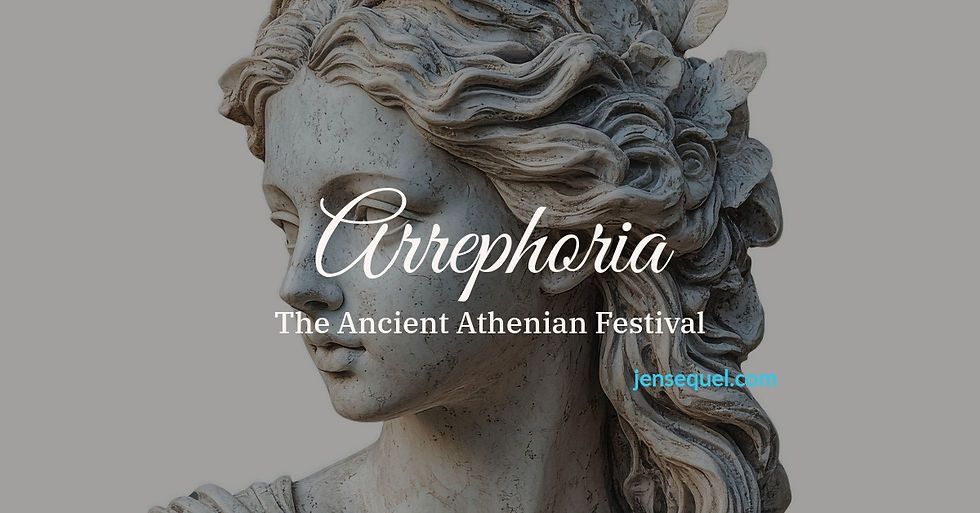
Among the many ritual observances that structured the religious life of ancient Athens, few are as quietly enigmatic as Arrephoria. Unlike public festivals filled with processions, sacrifices, and communal feasting, Arrephoria was a deeply private rite, centered on secrecy, movement, and the controlled transmission of sacred objects. It was dedicated to Athena and closely associated with the sacred precinct of the Acropolis, where the city’s most important religious traditions were anchored.
Arrephoria formed part of the broader cycle of rituals honoring Athena Polias, particularly those connected to purification, renewal, and the maintenance of sacred order. It involved a small number of participants—typically two young girls chosen from noble Athenian families—who were entrusted with a task so sacred that even the details were only partially revealed to them. These participants were known as the Arrephoroi, and their role marked a transitional moment in both religious practice and social life.
The festival took place during the early summer months, a period often associated in the Athenian calendar with transition and heightened religious activity. The Arrephoroi lived for a time near the Acropolis, serving Athena and participating in ritual duties before their final ceremonial act. Their service reflected a broader pattern in ancient Greek religion, where young women often participated in rites that symbolized passage, transformation, and the boundary between innocence and civic responsibility.
At the heart of Arrephoria was a secretive ritual journey. The two Arrephoroi were given covered baskets containing sacred objects, the contents of which they were forbidden to see or question. Accompanied by a priestess, they carried these baskets through a concealed passageway down from the Acropolis to a subterranean sanctuary associated with Aphrodite in the Gardens. There, they would deposit the mysterious objects and receive other covered items in return, which they carried back up to the Acropolis without ever knowing their meaning.
This movement between elevated sacred space and hidden underground sanctuary reflects one of the most powerful symbolic structures in ancient Greek religion: descent and return. The journey itself, rather than the objects exchanged, was the essence of the ritual. It embodied themes of secrecy, transformation, and the controlled circulation of divine power between different realms of the city’s sacred geography.
The association with both Athena and Aphrodite adds another layer of meaning to Arrephoria. Athena represents civic order, wisdom, and structured society, while Aphrodite embodies desire, fertility, and generative forces. The movement between their respective spaces suggests a ritual balancing of opposing principles—order and passion, intellect and vitality, civic stability and natural force.
Arrephoria also marked an important stage in the lives of the young girls who served as Arrephoroi. Their participation symbolized a temporary but significant liminal status. They were no longer children, yet not fully integrated into adult civic roles. The secrecy of their task reinforced this transitional identity, placing them in a space where knowledge was deliberately withheld and ritual action replaced understanding.
Ancient sources provide limited but suggestive accounts of the festival, most notably in works such as those attributed to Pausanias, who described the geography of Athens and its sacred sites. While the full details of the ritual remain obscure, this very obscurity is part of what makes Arrephoria so compelling. It belongs to a category of ancient rites designed not for public display, but for controlled transmission and symbolic action.
Unlike festivals that emphasized communal participation or dramatic spectacle, Arrephoria was defined by restraint. Its power lay in what was not revealed, what was not spoken, and what was not fully understood by its participants. This deliberate limitation of knowledge reflects a broader pattern in ancient mystery traditions, where secrecy itself functioned as a sacred principle.
For modern readers, Arrephoria offers a rare glimpse into the hidden architecture of ancient ritual life. It suggests that not all religious practice was meant to be seen or shared. Some of it was carefully contained, entrusted to a select few, and enacted in silence. In doing so, it preserved a sense of sacred mystery that could not be fully translated into public life.
Ultimately, Arrephoria stands as a reminder that ancient religion operated not only through spectacle and celebration, but also through quiet movement, concealed objects, and carefully structured secrecy. It is a festival defined not by what it reveals, but by what it deliberately keeps hidden—an enduring testament to the layered complexity of Athenian ritual tradition.

If you enjoy exploring forgotten traditions and strange festivals like this, you can find more in my Incredibly Strange & Completely Random Holidays series—available now on Amazon.


Comments