

Henry Fuseli and the Birth of Nightmare Art

Long before horror films learned how to frighten audiences with shadows, sound, and suggestion, painters were already experimenting with fear. One of the most influential among them was Henry Fuseli. His work didn’t just depict nightmares—it defined what nightmares would look like in Western art for centuries to come.
I’ve always been drawn to the intersection between art history and horror. The same imagery that inspires ghost stories and folklore often shows up in painting long before it reaches film or literature. Fuseli is one of those rare artists whose influence quietly threads through everything from gothic fiction to modern dark fantasy illustration. And once you see his work, it’s hard to forget it.
Born in 1741 in Switzerland and later active in Britain, Fuseli was part painter, part poet, and part provocateur. While many of his contemporaries focused on portraiture, history painting, or classical idealism, Fuseli leaned into something far more psychological.
He painted what happens when the mind slips out of control.

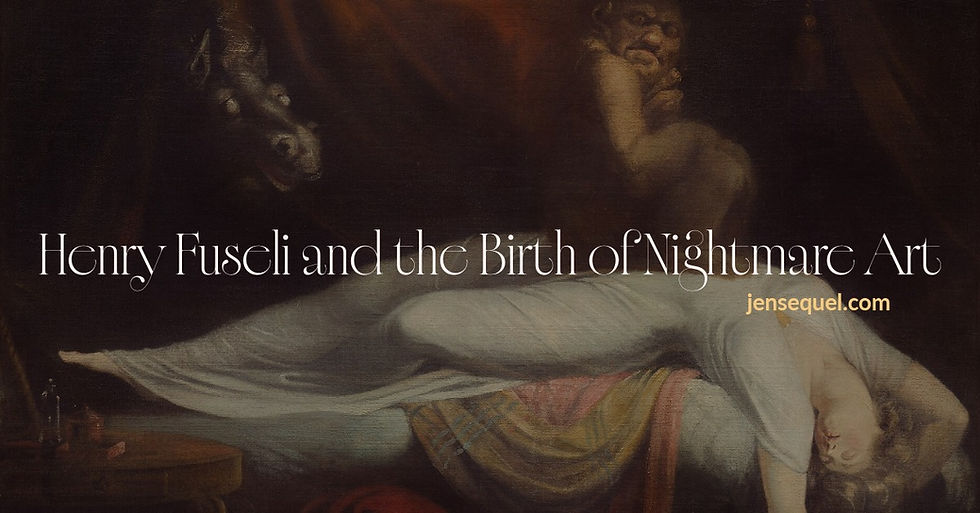
Henry Fuseli's most famous work, The Nightmare (1781), is one of those images that feels familiar even if you’ve never seen it before. A woman lies draped across a bed in uneasy sleep, her body collapsed in a way that suggests both vulnerability and surrender. A grotesque imp crouches on her chest. In the background, a spectral horse with wide, staring eyes pushes through a curtain of darkness.
It is not simply a scene, it’s an intrusion.
What makes the painting so unsettling is not just its subject matter, but its ambiguity. Is this a literal demon sitting on the sleeper’s chest, or a visual representation of sleep paralysis? Is the horse real, or a manifestation of dread pressing in from the edges of consciousness?
Fuseli never fully explains it. That uncertainty is the point.
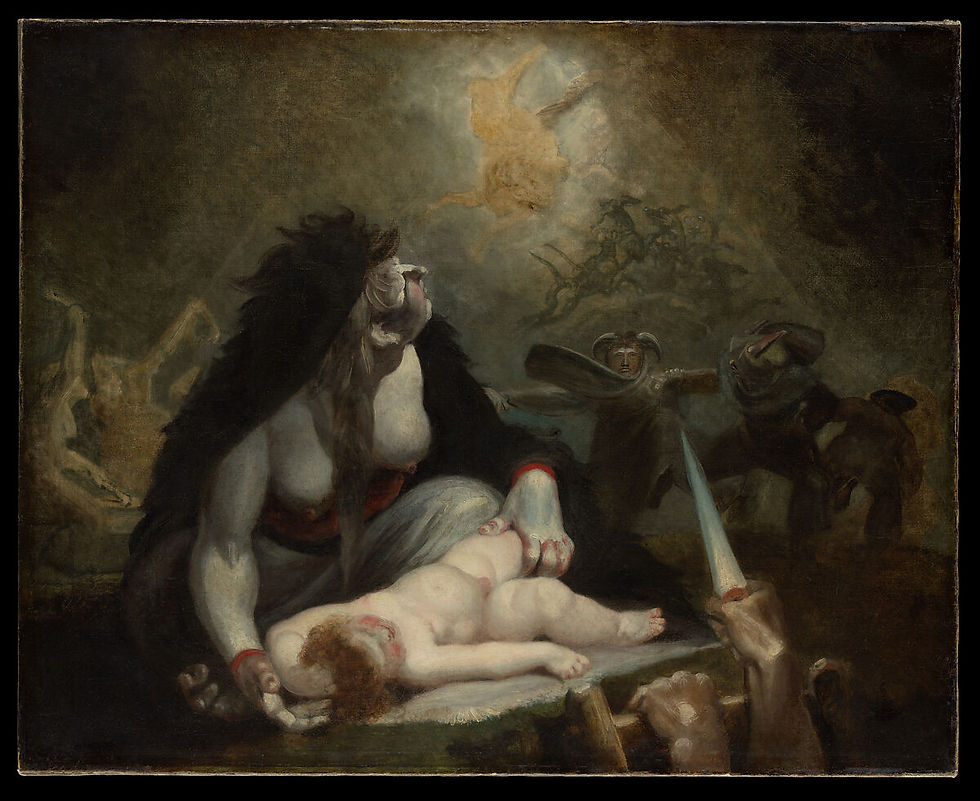
During the 18th century, artists were still deeply engaged with classical ideals—balance, proportion, mythology framed through rational structure. Fuseli disrupted that tradition by giving form to something far less orderly: psychological terror.
Instead of depicting monsters from myth, he painted monsters from the mind.
This shift is part of what makes him so important to the development of gothic art. Where earlier painters might have illustrated gods, heroes, or religious scenes, Fuseli turned inward. His work suggests that fear doesn’t always come from external forces. Sometimes it rises from within us, uninvited and unexplainable. That idea would go on to influence generations of writers and artists.
Romantic poets, gothic novelists, surrealists, and eventually modern horror creators all inherited pieces of that vision: the idea that imagination itself can become a source of terror.
You can see echoes of Fuseli in Mary Shelley’s Frankenstein, in Edgar Allan Poe’s psychological horror, and later in the visual language of gothic cinema. Even today, when we think of sleep paralysis demons, haunted dreams, or figures sitting on the chest of a sleeper, we are unknowingly revisiting imagery Fuseli helped cement into cultural memory.
What I find most compelling, as an artist, is not just Fuseli’s subject matter but his restraint. The painting doesn’t rely on action or movement. Nothing is exploding. Nothing is chasing the viewer. Instead, it holds stillness—heavy, suffocating stillness. The horror is suspended in place, like a thought you can’t wake up from.
That kind of tension is difficult to achieve, whether in painting or writing. It requires trust in atmosphere over explanation.

It’s something I think about often in my own work. Horror doesn’t always need to show everything. Sometimes the suggestion of something just outside the frame is more powerful than the thing itself. That principle shows up again and again in folklore, mythology, and modern storytelling. It is also part of what connects Fuseli to the broader evolution of horror as an art form.
Before there were film scores, before there were jump scares, before there were special effects or digital monsters, there was the simple act of placing something impossible into a believable space—and allowing the viewer’s mind to complete the fear. Fuseli understood that the human imagination is often more frightening than anything an artist can fully describe. That is why his work still resonates. It doesn’t feel like a historical artifact. It feels like a mirror.
We still see his influence in modern horror aesthetics: distorted figures, dreamlike lighting, impossible anatomy, and the recurring idea that sleep itself might not be safe. His vision helped establish a visual vocabulary for nightmares long before psychology gave them names. And in a way, that makes him one of the earliest architects of what we now call “nightmare art.”
Not because he invented fear. But because he gave it form.
For artists and writers today, Fuseli’s legacy is less about imitation and more about permission. Permission to explore the strange. Permission to leave questions unanswered. Permission to trust that ambiguity can carry its own kind of weight. As someone who works across both visual art and storytelling, I find that particularly meaningful.
Because whether I’m building a portrait, sketching something more surreal, or writing a scene that leans into the uncanny, the challenge is often the same: how much do you show, and how much do you leave hidden?
Fuseli’s answer seems to be: enough to disturb the viewer, but not enough to let them look away. And that might be the true birth of nightmare art.
Not the monsters themselves, but the moment we realized the mind could create them on its own.


Comments